Getting there is most of the problem
The technical work on a transformer is well understood. On a remote or cross-border site, what decides whether it happens is whether a team, its plant and its spares can reach the site at all, clear customs, and keep working once the road behind them washes out. That is the part we plan first.
Every section below describes work we do before a spanner is turned. It is the least glamorous part of the service and the part clients ask about first, because it is where projects far from a service base actually fail.
Logistics and entry
Equipment that is stuck in a bonded warehouse is not capability. Movement and clearance are planned as part of the programme, not left to the client.

Shipping
Sea, air and road, with container and flat-rack loading planned around what the destination port and the road beyond it can actually handle.
Temporary import
ATA carnet and temporary admission bonds, with re-export documentation prepared before departure. Test equipment enters and leaves as temporary import, not as a permanent supply.
Customs clearance
Tariff classification, duty treatment and clearance handled as a planned step with an owner and a date, not as an assumption.
Dangerous goods
Oil, solvents and gases carry declarations, packing and segregation requirements. Getting this wrong holds an entire consignment, not one drum.
Visas and work permits
Entry visas, work authorisation and local registration for expatriate technicians, started early enough that the paperwork is not the critical path.
In-country transport
Road movement to site, including abnormal and heavy load permits, route survey, and bridge and axle-load limits where the plant is large.
Site self-sufficiency
A remote site supplies nothing. Anything the team needs that has not arrived with it is a delay measured in weeks, so the deployment is sized to need nothing.
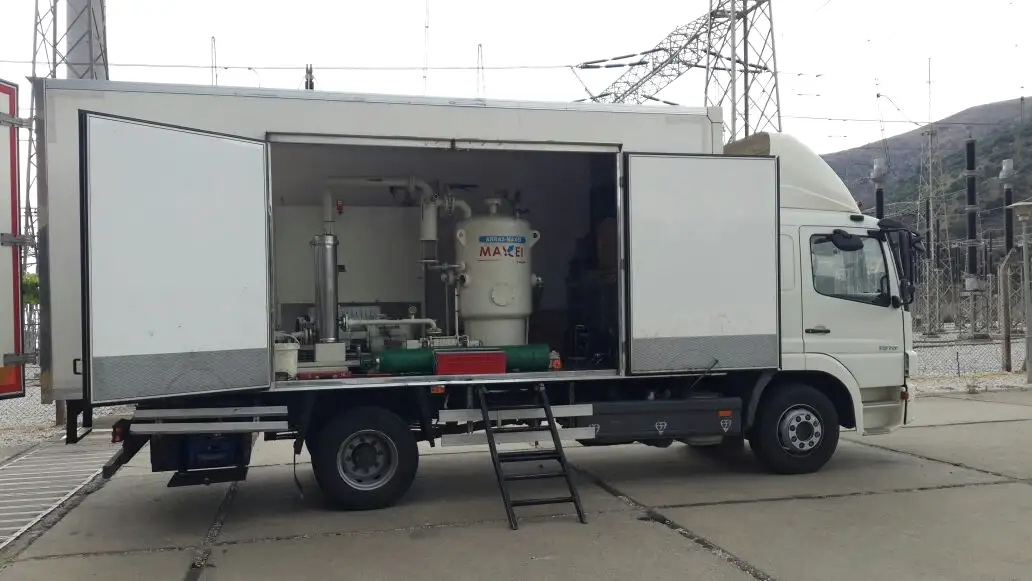
A truck-mounted vacuum oil-treatment plant, parked beside the switchyard. Own generation
Test sets and oil plant run from our own supply. A programme that depends on the grid it is there to repair has a circular dependency.
Fuel, water and consumables
Planned for the length of the deployment plus a margin, with resupply routes identified before mobilisation rather than discovered during it.
Accommodation and welfare
Where a site cannot house a team, the team houses itself. Rested technicians make fewer mistakes around energised plant.
Communications
Satellite where terrestrial coverage fails, so that test results, decisions and safety reporting do not wait for a signal.
A spares kit sized for the programme
Gaskets, seals, bushings, breather media and tap changer parts, sized for the scope of work rather than for a day visit. A missing seal should not cost a month.
Contingency
Planned against the things that genuinely stop remote projects: a part that did not clear customs, a road that became impassable, a generator that failed. Each has a named alternative before departure.

Programme management
The plan is made against the site's real constraints, which are rarely the ones in the specification.
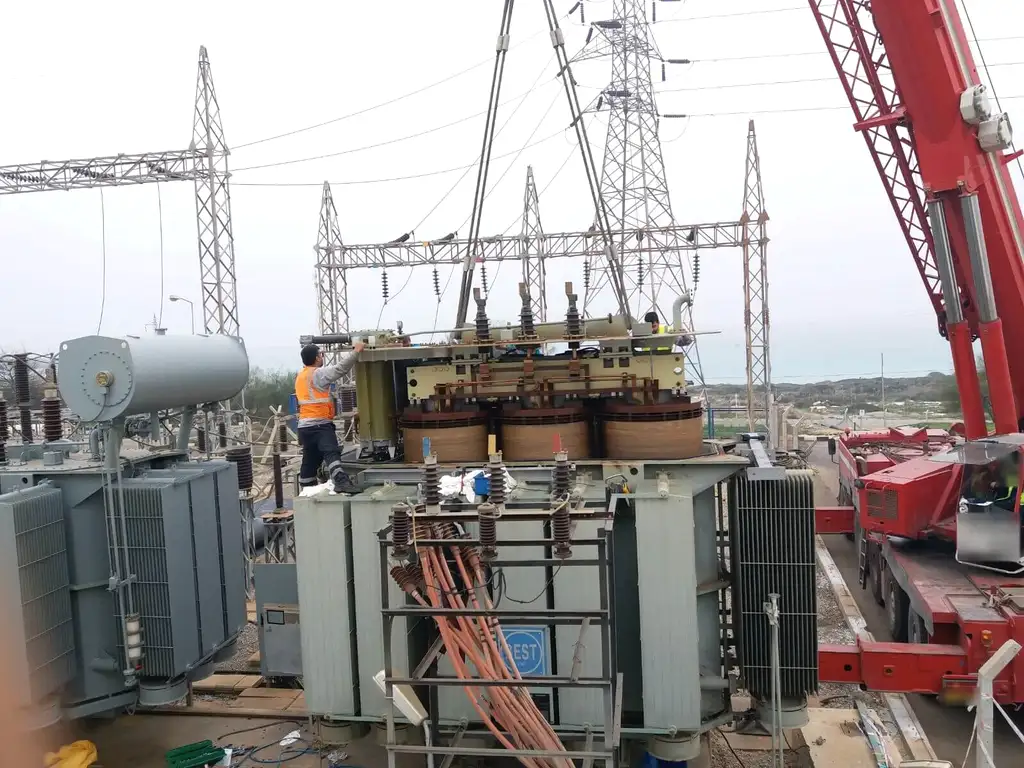
An active part lifted from its tank in the switchyard under a mobile crane. Site survey before commitment
Access, ground conditions, crane availability, supply, and the actual state of the assets. Quoting a transformer programme without seeing the site produces a price that changes.
Outage windows
Work is scheduled around when the asset can be taken out of service — a regulated outage plan on one network, a load-shedding rota that moves on another. Both shape the plan more than the scope does.
Local partners and subcontractors
Where local capability exists we use it, manage it, and are accountable for it.
Security
Assessed per site, with protocols agreed before deployment where conditions require it.
An HSE regime that travels
RAMS per task, permit-to-work, lock-out tag-out, switching discipline, confined-space procedure for tank entry, and arc-flash assessment. The regime arrives with the team; it is not adopted on arrival.

What a mobilisation actually looks like
Eight stages from first contact to demobilisation. Clients on a programme can follow their own project against these stages.
Enquiry
Assets, site, symptoms and constraints. Enough to say honestly whether we are the right supplier.
- 02
Site survey
Access, condition and scope confirmed on the ground before a price is fixed.
- 03
Mobilisation plan
Equipment list, shipping route, clearance path, permits, team and dates.
- 04
Shipping and clearance
Consignment moves under temporary import, with clearance tracked to a date.
- 05
Team deployment
Technicians travel once the plant has cleared, not before.
- 06
On-site works
The scope executed against the agreed method statements and safety regime.
- 07
Testing and handover
Post-intervention test evidence, compared against the pre-intervention baseline.
- 08
Demobilisation
Plant re-exported, site left clean, used oil removed under a documented chain of custody.
A real mobilisation
One specific, verifiable example is worth more than everything above it. This section stays empty until there is one.
Nothing is published here yet
Tell us where the site is
If the access is difficult, the customs position is unclear or the outage window is short, those are the parts we plan first. Start with the site and the assets.